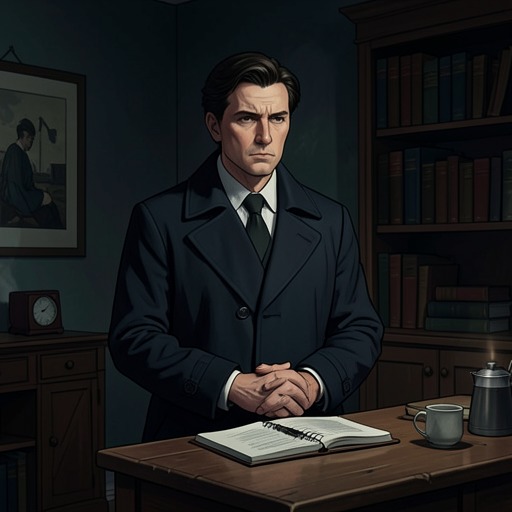
Confession and revelation of Maori’s amnesia during the park date
Even If This Love Disappears From the World TonightThe confession and revelation of Maori’s amnesia during the park date is the turning point at which Tooru Kamiya and Maori Hino’s tentative closeness becomes inseparable from the practical and ethical demands of her condition. Tooru’s admission that he can no longer hide his feelings is met not with a simple acceptance or rejection, but with Maori’s disclosure that sleep erases the day from her memory. The scene makes love a question of how to live with a relationship that one person may have to rediscover each morning—and whether its most important moments should be written down at all.
A quiet intimacy before the confession
The date has no grand occasion to distinguish it. The two talk about nothing in particular, smile, admire each other, and look around the park; when the conversation falls away, the silence is comfortable to Tooru. That ease matters because their connection has not begun with an uncomplicated romance. He understands their bond as unusual and recognizes that they do not like one another in the conventional sense, yet he is grateful to spend his day off beside Maori. Their unforced quiet gives the confession a setting built from ordinary companionship rather than spectacle.
Tooru’s feelings become undeniable in a small, physical moment. After the silence, warmth and happiness spread through him: he savors the sun, the smell of grass, and the presence of the person sitting beside him. A strong wind blows; Maori holds back her long hair. In that instant, he wants to tell her what he feels. The scene links the admission to the modest life they have already made together: not a dramatic declaration prompted by a crisis, but an emotion that has emerged through time spent sharing an ordinary afternoon.
Confession and refusal
Tooru asks, “Is it okay if I fall in love with you?” He realizes, as he speaks, that the question makes his feelings real to him. Maori turns toward him and replies, “No, it is not.” Her answer initially appears to close the door, but her hesitant response—she looks down and struggles to speak—makes clear that the refusal is bound to something she has not yet said. The wind rises again as she begins to explain, giving the disclosure a pause and a weight that neither character can simply talk past.
Maori tells Tooru, “I have a disease. It’s called anterograde amnesia. When I go to sleep at night, I forget. I forget everything that happened that day.” The revelation reframes her answer: she is not merely rejecting his feelings but telling him what intimacy with her entails. Tooru has asked whether he may fall in love; she responds by disclosing that the relationship’s continuity cannot be assumed. An exchange about affection becomes an account of a condition that divides her life into days and places a limit on what she can carry from one to the next.
Memory as a daily circumstance
The scene’s implications become clearer through Maori’s own records and routines. After the accident, she maintains a binder for essential information and a more personal journal whose entries begin the day after the accident. She reads the binder and journal each morning, and her mother has adjusted her schedule to support this routine: Maori must go to bed by ten at the latest, and her mother leaves her to read on her own, remaining downstairs if she has questions. Her memory loss is therefore not a single revelation in the park but a daily condition managed through written records and family care.
The binder also explains why the condition has been kept from Maori’s classmates. Her parents consulted the school, where they were told that she could graduate if she attended and met the required number of days. School administrators also warned about the risks of exposing her memory loss: if rumors spread, other students might come to see her, and information could travel beyond the school. The concern is that she could be harmed and forget what happened the next day. This reasoning does not present secrecy as a simple preference. It is a protective measure shaped by the possibility that a condition which disrupts memory could also make it difficult to report or retain a harmful experience.
The school’s response provides a separate, institutional accommodation. Maori’s teachers know about her condition and do not call on her in class. She submits homework blank and sits her tests, though the results do not matter; as long as she attends, she can graduate. The arrangement keeps her enrolled, but it does not restore the academic path she had worked toward: her journal records that she had studied hard to enter an advanced class, only for that effort to lose its former meaning after the accident. The park conversation thus sits against a wider reality in which each day of school is both a way to remain in education and a repeated encounter with what her memory will not retain.
The request not to write it down
After Maori has disclosed her condition, Tooru asks what happens if she does not record the day. She confirms that she would wake believing the accident had happened the day before. He then makes an unexpected request: “Then don’t write down that you told me about your memory loss. And don’t write that I confessed and said I love you.” He speaks quietly and leaves out the question mark. The request is not to deny the condition itself, which is already recorded, but to keep this particular exchange out of the records that will otherwise carry the day forward for her.
Maori hesitates for a long time before agreeing: “All right. I won’t write down what happened today. I’ll forget it.” For her, forgetting is literal, not a figure of speech. Tooru understands that if she neither writes down her actions nor records this conversation, the events will vanish from her accessible account of the day. Their agreement therefore makes the date a deliberate exception to the method by which she usually preserves continuity. Its intimacy lies partly in what they choose not to preserve: she consents to forget the confession and her disclosure, while Tooru accepts that the moment he has named may not be present in her memory tomorrow.
Their conversation also establishes that staying awake can delay the reset, but not solve it. Maori says that if she remains awake all night, her memories last into the next day; she and Izumi Wataya have tried it and learned that people cannot live without sleep. The fact offers no sustainable alternative to her routine. Tooru learns that the records, rather than an attempt to avoid sleep, are central to how Maori meets each new morning—and his request asks her to withhold only the record of the meeting between them.
The relationship shaped by the disclosure
The disclosure changes what Tooru thinks a relationship can offer. He cannot assume that shared experience will accumulate for Maori in the same way it does for him, so he begins to imagine the journal not only as a record of loss but as a place where future versions of her might find reasons to look forward to ordinary life. Seeing how long her list of things to do is, he thinks of filling it with happy experiences so that tomorrow’s Maori can feel braver and less afraid of the future. His response is practical as well as romantic: rather than treating her memory loss as a reason to withdraw, he looks for activities they can share and records that may help those experiences matter beyond the day in which they occur.
That response is not a claim that written memories can undo the condition. The records help Maori learn what has happened, but she still wakes without personal recollection of the previous day, and she can find it painful to discover that loss again. Tooru’s hope is more modest: shared plans and entries may give her a reason to welcome a life whose continuity has to be assembled from notes, routines, and other people’s care. The scene’s importance lies in how directly it joins affection to that work. His feelings do not make her condition disappear; her disclosure instead forces him to ask what loving her would mean in its presence.